Wednesday, December 27, 2017

Ang Larawan: Can investing in art be a valid retirement plan?


The MMFF entry "Ang Larawan," (Dir. Loy Arcenas, 2017) which was based on the musical, which in turn was based on the play by Nick Joaquin and translated by Rolando Tinio,  poses quite a financial situation still relevant to a lot of Filipino families. How does one prepare for retirement and old age, particularly if one is (a) an artist and (b) a single and unmarried female dependent on other family members. Of course, there is also the question of how Pinoy society values art. But at the moment, I'm interested in how can art be a vehicle for retirement. 

The painting in contention was created by Don Lorenzo El Magnifico, supposedly a contemporary of Juan Luna. He crafted an obra maestra in his old age, and mostly everyone observed that The Portrait of the Artist as Filipino did not appear to be Pinoy at all in terms of imagery. It showed a scene from Virgil’s Aeneid: Aeneas carrying his aged father Anchises away from the burning city of Troy. The painting was said to be a self-portrait: it was effectively a young Don Lorenzo carrying his old self away from destruction.

After painting this obra, he suffered an accident—fell from a second storey window and down into the courtyard. He was checked by all the doctors and nothing was wrong with him, and yet he refused to leave his room. 

The painting got people interested in an old master that they thought was already dead. A Frenchman raved about it; an endless stream of students, journalists, photographers and critics trooped to the Marasigan house to view the painting—much to the consternation of his two old maid daughters Candida and Paula, to whom he has bequeathed this masterpiece. 

Similar subject by Italian painter Pietro Testa. 


The daughters face a difficult situation: they are dependent on padala of their two elder siblings Manolo and Pepang for their expenses and the house’s upkeep. Candida and Paula have even taken in a boarder whom they despise: Tony Javier was a vaudeville piano player. Unschooled but ambitious, rakish and brings home rowdy women, drinks chocolate lecherously from someone else’s cup. But his rent brings them money, so they tolerate him. 

But even that doesn’t seem to be enough as Candida and Paula do not have enough to pay the bills from the kuryente, the tubig. The sisters have a plan: Candida considered a newspaper ad where one would get paid to catch and kill rats just so they could pay bills. Paula could put up a signs outside the house announcing that she could tutor females how to play the piano, and males on how to speak Spanish—frankly a skill that was disappearing in 1941, on the edge of a war and a Philippines that has been under American rule for decades. Manolo and Pepang didn’t like this plan: they asked the sisters to take down the signages outside the house (Nakakahiya!). They planned to sell the house, take the furniture for their own children who are about to get married and start families of their own. What’s worse is they planned to separate the women, take one each to care for their own households. Such is the fate of dependent elder unmarried women at the time. 

The one thing that could save Candida and Paula from financial ruin was The Painting which their father told them to do as they pleased. Tony Javier has a ready buyer, an American willing to pay $10,000 plus his commission for convincing the sisters to sell. The sisters are unwilling, but Tony lists all the things even he could do with his own commission: go wherever he wanted, to go to Europe, to South America, finally formally study the piano, breathe in some culture. It would buy him decency away from his very precarious situation. 

Tony Javier enticed the sisters with this possibility of financial freedom, of no longer worrying about the bills, what the neighbors would say, doing whatever he wanted without fear. All this for ten thousand dolares in exchange for a painting done by their dear old dad. So a question: How much was Don Lorenzo El Magnifico's painting worth? Can art be a valid nest egg for retirement and financial freedom? 


In the movie, the price of the painting was $10,000 in 1941, which was something like Php20,000 at the time. So there was a 1:2 ratio in the exchange rate. I tried to find out what the painting could cost now. 

calculator.net computes for inflation using US CPI data. I plugged in $10k in 1941 and that amounts to $172,216.04 in 2017. At the current exchange rate of Php49.94:US1, it means that $172,216.04 (49.94) = Php8,600,469.04. 


Ronald Ventura's "Grayground" was sold for nearly Php47M.


Php8Million for the work of an old Philippine master seems like peanuts. It should cost more, specially taking into account that even relatively young Philippine artists are topping out at USD1Million per work. There’s Ronald Ventura’s “Grayground” for Php46.9M or Geraldine Javier’s “For She Loved Fiercely” which sold for HKD 1.46M or Php8.8M. A Fernando Amorsolo painting done in his prime sold for Php20M at an auction. National Artist BenCab’s “Sabel” fetched Php20M. The biggest “Sabel” was priced at Php46.7M.


For comparison, I looked up the price of a Juan Luna painting in the market. That same article which sold the “Sabel” mentioned an “untitled Luna” featuring a lady dressed in the fashion of the time sold for Php14M. Perhaps the most controversial Luna piece in recent memory was “Parisian Life,” which was purchased by the GSIS at an auction in 2002 for Php40M. It caused an uproar at the time, and for which the GSIS caught flak for “wasting the public’s money” for an artwork. But the painting is now valued at Php300M, which was 650% higher. 


Juan Luna's "Parisian Life," bought by GSIS for Php40M in 2002.


In the film, Manolo and Pepang brought in the women’s godfather, a senator of the republic, to convince them to sell the painting to the government. It seemed like an echo of the government trying to buy the painting to preserve culture and memory, and at the same time, the sisters could have funds to care for themselves.


Juan Luna's "Espana y Filipinas" was worth Php156M. 


Don Lorenzo’s self-portrait was smaller than Luna’s “Spolarium" but bigger than “Parisian Life.” It should be priced similar to a rare Luna "¿A Do...Va la Nave?” that sold also at a bidding for Php46.7M or to a version of "Espana y Filipinas," which was auctioned off for HK$25.88 million or Php156.52 million. 

At its bare minimum, the work of an old master who was Luna’s contemporary should be priced in the vicinity of a “rare Luna” at Php8M minimum, to an intermediate price of USD1M similar to a young contemporary auction star. Or if we follow the auction for old masters, a major work should fetch anywhere from Php46M maximum or Php156M.

So anywhere from Php8M, 46M or 156M. 

Even if “devalue” it by saying Don Marasigan was *not* Luna and slash the price by half, that would still be a decent Php4 to 20M, that should buy Paula and Candida a modest but secure retirement in their old age. But at 46M or 156M or even “Parisian Life” levels at 300M could buy them and their family financial security for generations. 

ART FOR RETIREMENT

So is art a valuable and valid piece of investment for retirement? If it’s the work of an established master, yes. Just going by the appreciation of Luna’s “Parisian Life” from Php40M to 300M in 15 years is proof of that. Even a minor and rare Luna that sells for Php8 million is a godsend. But how many obras of old masters do we have lying around? 

If you are young and can go “speculative,” I would probably get a major work by a relatively young and upcoming artist and hope he does well in the future so that the value of my purchase could appreciate in the decades ahead. Better if he becomes a National Artist. 

SPOILERS AHEAD: 

All the hypothetical pricing seems wasted as Paula decided to destroy the painting so they could be “free.” As in start from scratch.  I could imagine Paulo Avelino's Tony Javier quaking in desolation as his future was destroyed just like that. But it wasn't his painting.  


Wednesday, December 20, 2017

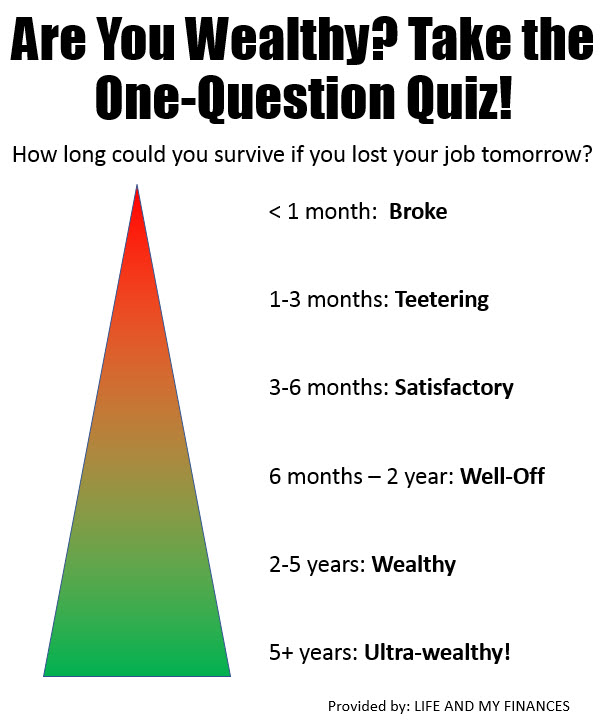
How Wealthy Are You?


Here’s a stealth wealth/net worth revealing challenge if ever there is one: 

If you were to lose your job tomorrow, how long can you survive? 

I came across this from J. Money of BudgetsAreSexy, who picked it up from LifeAndMyFinances. 

This is a question that will be recognizable to those who work part time or are on perpetual “casual” employment contracts that get renewed on a term-to-term basis. I realize that I’ve been in this situation almost my entire working life: from the media job that subsists on getting projects lined up one after the other, to the government job that needs you to write a “renewal” letter at the end of each year, to the part time or adjunct academy circuit where people juggle at least two jobs at a time. 

Two words that are the source of unspeakable horrors: Lean years. This is something we all have to live with for the next 3 years at least. Where I’m at, there’s nothing that makes you more aware of your precarious work situation when the end of the term comes and you have not yet received your assignment or “load” for the next and will only learn about it on the day before you start. And even then, it’ll be a surprise as to how much load you’ll be carrying. In some places it’s not so bad, where planning starts in the middle of the term and you more or less know if you have to take on more gigs.

I think if you throw this question at most part timers, there’s going to be much agony and much scrambling to apply in other places. 

As for me, if I got called to the boss’ office and got told that there’s nothing for me come January, I don’t think I’ll panic. 

Yet. 

There are several things working to my advantage: 
  • I’m single and have no kids. 
  • I don’t pay rent. But I pay for household bills and expenses. 
  • I’m relatively healthy. 
  • I live frugally. 
  • I’ve built an emergency fund.
This last item I owe to a series of lucky breaks: 

Some years back, when all the talk about K-12 came up, the Posh School designed a plan where they will “front load” all the part timers—meaning give every one of their contractuals the full allowable work load as a way to save up for the lean years. That meant I had a few terms where I was getting double the usual work I had. 

Then I discovered that they’ve been computing my pay rate wrong. The accounting office used the entry level rate where I should be at another rate. So I received wage adjustments for a full year’s work. The bad part was that accounting gave it at one go so that’s a whopping 30%++ in taxes. That’s when I put that money in a brokerage account. 

Then I started at the Big School which allowed me to rack up some more savings. Then this year I let go of that original Posh School. 

But I recognize how lucky I was about those “front loading” terms and the miscalculation of wages which lead to me accidentally building an emergency fund. 

Plus, my entire work life I’ve been used to this boom and bust cycle. After getting paid for a project, I tend to hoard it because I know that the next pay cycle is going to be a long ways down the road. Setting up a new project or getting a new gig takes time, and one must allocate her resources a bit more sparingly. 

To answer the question, just how long will I last if I lost my job tomorrow? 

From Budgets Are Sexy


Provided that I maintain my frugal ways and don’t have to pay rent, then I can live 6-9 months on emergency funds. 

If it’s really really tough and I have to rely on my entire net worth, then it could be upwards of three years. 

It's not much. As someone who knows what it's like to be really poor, it is a whole lot better. 

I suppose my only regret is that no one told me that money shouldn't really be sitting in a savings account. Otherwise, maybe I have a shot at joining the super elite ultra-wealthy category. But as they say, there's no better time to start investing than today. 

From those other blogs, that qualifies me under the “wealthy” category, although I can assure me that I don’t really feel wealthy. I don’t really own a lot of material things, save for a few gadgets like a laptop, a tablet and a phone—things I need to work. Other than that, I don’t really “own” anything.  If a thief broke into my house, I think they’ll be very disappointed to see boxes of books, some clothes, a ton of paper and not much else. 

Doing this exercise somehow reassures me that I don’t have to run and pimp myself out as the world's worst hooker, or sell a kidney or two. But still, in these highly precarious times, we all need to have a Plan C. I’m already on my Plan B so I need a back up on my back up plan. 


Saturday, November 25, 2017

Challenges Millennials Face in the Stock Market


Image by Samantha Gonzales / Business World 


I came across this article by Fehl Dungo of DailyPik encouraging millennials to invest in the stock market. The Philippine population is now dominantly young—with an average age of 22, it puts our country in a sweet spot that allows it to grow in the next 30 years. Which means that young people have a lot of time ahead of them to let their money grow. 

There is also ease of access. Stock trading and investing used to mean having money enough to fund a broker, whom you call to buy and sell stocks for you. But with a number of online platforms, all you need is a minimum of Php25,000 (perhaps even less) to get started. Once online, you can now personally choose which stocks you want to trade, in real time, as long as you have access to good internet. 

Now this is where things get interesting. Yes, I agree with most of the article: a young population, coupled with a long time horizon and ease of access to trading—all of these favor the young. And perhaps the challenge would be combatting the nature of youth as well. 

Hello, FOMO and ADHD. 

Once online, not everyone is educated enough to know which stocks to pick and how long to hold on to it. Look at trade forums and Facebook groups, and you always get that newbie question: “Hi, I have ___ thousand pesos. What stock is good to invest in?” Then other members would jump in with “recos” of their favorite stock. It’s very tempting to jump on the loud, popular, trendy stocks. It’s so easy to fall for “hyped” stocks if you don’t know what you’re getting into. Most of the time, newbies then buy those “hyped” stocks. You see the price going up and then you chase it all the way to the top. Then cry and complain online when the price of the stock they just bought start correcting. It’s succumbing to the fear of missing out, or FOMO. 

When the price falls, you switch to another stock which starts to move fast, hoping to recover your losses. Do it again and again and your capital might just be wiped out by bad, ADHD trades. 

This could be easily avoided by studying the market first, then the stocks and the companies behind them. One also needs to be patient. A stock you buy now might climb high and then correct, so be prepared for that. Don’t panic and dump it all to transfer to another stock. 

In a way, I’ve been one of those ADHD/FOMO traders. Had maybe 5-6 stocks on a less than Php50k portfolio. The gains and the losses basically just cancelling each other out and leaving me with minimal negligible gains. Jumped on a stock that seemed like a good idea and then it started to drop and drop. Cut my losses, only to see that stock climb up again. 

I learned from it and started pruning my portfolio. Sold all the losing positions and placed my money on an undervalued stock. After 4-6 months, it went to its all time high. But I didn’t know how to lock in gains, or place a stop loss. I saw a stock with 70-85% in gains wither down and melt to a negative port. But I held on through those rough, red months. Waited for the stock dividends, saw it climb up, go down, sold some. Yet all told, after holding the stocks for around 16 months, the stock has gained over 115%. 

Of course, there are still a few coulda, woulda, shouldas. Shouldn’t have sold when the price was going down. Should have added on that sharp drop. These are hard lessons to learn, and I’m still learning. 

The Philippines has a population of over 100M, and depends on the data you look at, only less than 1% invest in the stock market. We also have a low financial literacy late, and a large part of the population that’s unbanked.

Another interesting development is that the profile of investors has changed and has “skewed towards the lower income bracket.” Those with less than Php500k income per year are now 40% of online investor accounts. We are expanding, but we still have a long way to go. 


So, yes, we should invest in the stock market—not just millennials. Heck, even the Titos and Titas of Manila need to learn more about how money works and how saving and not spending it all on #travelgoals will help us in the long run. It’s not about #FOMO-ing on the trendy, hot stock. We need to be patient and diligent, in order to be truly #blessed.

Saturday, November 11, 2017

Bob Ong: Living Off Writing

Bob Ong's proof of life: his 1998 Webby PH Award


I found out too late that Bob Ong, author of the book ABNKKBSNPLAko?! and probably responsible for getting a lot of Pinoys to read, had an AMA (Ask Me Anything) session at Reddit PH. 

It took place on October 26 between 1-3PM, but because of the huge interest, it took him a good 6 hours to answer all the questions posted for him. 

While I didn’t make it on time to personally ask him a question, my favorite queries have to do with what Bob Ong does with his time. He said he fills his days with “hayop at halaman.” So basically it’s a more leisurely, less stressful life in what is probably his middle age years. 

From Bob Ong's Reddit PH AMA


What enables this life? A reader asked this: “At what point in your career did it become self-sufficient just by writing books?” 

Bob Ong said that he doesn’t really need much and lives with just water and a loaf of bread. Of course I understand that’s *not* literal. But because he lives simply, he’s been able to afford his life of “hayop at halaman,” and his peanut butter and bread by the time he published his second book. 

Part of his “proof of life” post was a picture of his Webby Award from 1998, which he got for the “People’s Choice for Weird/Humor.” This means that Bob Ong has been writing for nearly or more than twenty years, since the early days of the internet. Two decades! Wikipedia (not the best source, I know) lists his second book as “Bakit Baligtad Magbasa ng Libro ang mga Pilipino?,” which came out in 2002. This implies that if he went “self-sufficient” *after* the second book, then Bob Ong has been living off his writing by 2003. That’s nearly 15 years of living as a creative person. 

I’m not sure if he’s still working a day job. But he does mention that only his friends and family know of his true identity as Bob Ong. So if he does have co-workers still, then they don’t know they’re breathing the same air as greatness. (Naks!) 

Still interesting is that someone has been going around introducing himself as Bob Ong and then proceeds to ask for discounts and freebies in restaurants. Not cool. But then perhaps expected that someone will try to steal his identity since Bob Ong is famously reclusive and we don’t know what he looks like despite the two decades of his publishing life. 

But still, this is a goal. It’s possible to live off creative work, but then Bob Ong is like the one in a hundred million in the Philippines. You have to be Bob Ong successful to be able to do this. But the real take away for me is that you need to live simply and want not. I’ll be happy with living with “hayop at halaman” for the rest of my days. I think. 

Saturday, November 4, 2017

What to do with your (championship) bonus

Bonus season is coming. 

The thirteenth month (or 14th and even 15th if you're lucky) is something that employees with regular jobs look forward to come November or December. Unfortunately, once the money is there, most people will spend it on expenses, paying back debts or bills, or worst, living large. Before you know it, it's all gone. Or as one saying goes: "Dumaan lang sa palad," or "Nahawakan ko lang sandali, wala na agad." 

Yes, the 13th month is mandated by law. But if you're a "service provider" or "contractor," then that extra money is dependent on the largesse of those we work for. 

Similar to gig workers, athletes are notorious for having boom and bust careers. At their peak, they can command super high salaries. It’s easy to live large if you’re also earning outstanding sums of money. The wear and tear on the body is just too much, that by age forty, it’s time to consider retirement. But they are also prone to injuries. And all it takes is one misstep, one moment before the sport you love leaves you debilitated, in pain, and worse, bankrupt. 

In the Philippines, we see this fate in our athletes. Item: At 63 years old, Efren “Bata” Reyes is still playing the rounds because he can’t afford to retire yet although he already wants to. In his heyday, a championship could get him $100k. Competing in tournaments abroad cost a lot of money now. Expenses could be as high at $5,000 and you need to place at least third to break even. These days, he admits things have changed. After an eye operation in 2005 and an unsteady wrist and tiring easily, Reyes cut short his stay in the US , citing fatigue. 

Item: Then there's Rolando Navarrete, former boxing champ who went on a drug addiction down spiral and is now broke. 

It’s just sad to see them like this. At their peak, with all their money, there will be entourages and people who ask for a little help. But one should also think about the future. 

I don’t follow basketball as much. But I’m glad to come across this piece of news: the bonus received by Scottie Thompson of the Gin Kings was enough to open “three, four” franchise branches of a barbershop. What’s better: the article from Spin reveals that the business was his own. With a capital of nearly 1 million pesos, Scottie debuted Thompson’s Sports Hair Shop in his hometown of Digos in Davao in late 2016 and now has a franchise out in Paranaque. He’s also gotten some more inquiries about opening up branches in other places. His shop’s signature service, the Thompson’s Cut is relatively affordable at Php120, but also has a student friendly rate of Php99. He’s even thinking of learning the trade himself. So it’s not farfetched that you will have a PBA player cutting a customer’s hair. 

All in all, it’s good that he was already thinking ahead. At 23, he’s only going into his third year playing professionally in the PBA. But he knew that he wasn’t going to be in the game forever, and it was never too early to plan for the future. 

So if you get a windfall or receive your 13th month pay, don't spend it all. Be like Scottie: enjoy some of it, and then save and invest the rest of it. 

Good job to that and congratulations on the championship, Scottie Thompson. 


Monday, October 30, 2017

#WalangPasok, Walang Sweldo

The City of Manila cancelled classes for October 30, which means that there really are no classes for the entire week until November 3.

While students are probably rejoicing, I can sense the groan of all the part-time faculty who are mostly no work, no pay.

If you consider the many school cancellations because of bad weather and the transport strikes, and even the upcoming ones for the ASEAN summit, many part-timers are looking at reduced circumstances indeed. November alone only has two weeks' worth of work/pay.

Of course, not all schools have the no work, no pay rule. Some schools still pay you, but you can be sure that there will be some institutional make up classes down the road because they can't be giving you money for free.

All in all, I'm not a fan of this cancellation at even the slightest hint of ambon. Or cordoning off huge swaths of the metropolis when VIPs are in town. It started with the Pope's visit a couple of years ago. You literally cannot go out of your house and go somewhere else when there are road blockages. It seems like the Philippine government has become fond of this particular strategy. Freeze off parts of the city so they can have "security" for the VIPs.

On the other hand, not all sectors are happy with this. When government work is cancelled, so other important transactions are also at a standstill. The financial markets has opted to remain open during the ASEAN Summit on November 13-17. A good thing really, because lost days mean a loss of revenue and lost time for all.

Monday, August 21, 2017

Pecha de Peligro Meals


Hoy! Gising gising from reddit user bulalosataginit


Most young people--yuppie, hipster, millennial or student alike--probably know what it's like to run out of money way before the next payday or allowance arrives. That precarious period usually run the week or so before payday, locally known as pecha de peligro--literally, dangerous days. 

This comes mostly from not knowing how to budget their money. Whether you're the newbie fresh grad on your first job, or had way too many bills, or way too many #drinkstagram posts, or your parents are also having a hard time and hence the allowance delay, you know that feeling of not even having enough money to eat. 

Most probably consider instant ramen (the add water or in a cup kind) as the ultimate meal of last resort. I've heard instant noodles being referred to as "poverty food," and they're not too far from the truth. Just thinking of all the salt and additives makes my liver quiver. But for a vast majority of Pinoys on a tight budget, that's all there is too eat. You're even lucky at that point you're not eating pagpag--meals cooked from those discarded by fast food outlets and sold by the kilo in the poorest areas in the metro. So yeah, poverty food has different levels of hell. Consider yourself lucky if you're eating instant noodles.

For the part-time worker, these days are even more real especially at the end of a work term. You don't get your whole salary but only half of a half salary. You get probably a week's worth. The other half of your half salary you only get once you have been "cleared" after the last work requirements are submitted. That clearance process itself also takes some time since the paperwork requires a half dozen signatories or so. What's more: you don't get paid until a month into the next work season. So yeah, these are definitely salad days. 

Learning to cook to feed oneself is a valuable “adulting” skill. Admittedly though, grocery stores are a more convenient place to get food. Don’t rely on supermarkets and groceries, as ingredients there wouldn’t be as cheap compared to what you can buy at the wet market. Once at the market, opt for vegetables as these are cheaper than most meats. Check out this stir fried cabbage recipe with ham via MarketMan, which comes out cheaper than a fast food value meal. He also has a slew of delicious, nutricious, but lower priced dishes here. 

Market Man believes that yes, although times are tough, prices of raw ingredients are rising, we should know better than just succumbing to buying fast food meals to feed ourselves. That the Php49 fried chicken meal can be replicated at home, for far cheaper. He urges readers to cook more, cook smarter, and cook at home. 

My favorite resource of these cheap meals come from reddit ph user whose pecha de peligro recipes are real helpful. Check out these inexpensive recipes for spicy ginisang sayote and Hoy! Gising gising. There’s even a Valentines Special for those affordable date nights. 

Then there’s also the ultimate in Pinoy tipid foods: the delata or canned goods. There’s still a huge spread in terms of price: CDO Carne Norte at Php29.75/40 is way cheaper than the more gourmet Delimondo Corned Beef at Php120. And you still need skills to transform that into a meal and not just open the can and eat. 

Basically, my point is this: if you were not careful with your money, then you will always find yourself in a tough spot where you can only eat Sardinenuts— sardines with crushed Nagaraya nuts. That’s on you. But if you had cooking skills, then even sardines with nuts wouldn’t taste as bad. At least, that’s better than starving.