Showing posts with label economics. Show all posts

Monday, September 10, 2018

Tinola is now a luxury

This tinola pic from Kaukau Time! blog


Nearly a week or so after the scandalous Php1k/kilo of sili, the Agriculture Secretary Manny PiƱol himself tells the public that they should plant sili for self-sufficiency. I mean, sure. But where will the ordinary office bound Pinoy worker find the time to plant bahay kubo vegetables if they're still stuck in traffic? 

This article by the Inquirer looks at those in the informal sector who are hardest hit by the inflation: an ambulant vendor and a tricycle driver with a family to feed. They can no longer afford tinola--something that I had encountered when trying to buy ingredients the last time I went to the market--and have to set aside half of the hotdog and tilapia they had for lunch and have it for dinner. 

The prevailing minimum wage in the National Capital Region is Php512, and if it wasn't enough before, it certainly isn't enough to catch up with the 19.2% and 12% rise in price for vegetables and fish. There are groups that want to raise the minimum wage to Php750 and to provide discounts for basic commodities. 

The Associated Labor Unions-Trade Union Congress of the Philippines also lobbies the government to curb the rise of inflation and its effects on the poor. “The unemployed are obviously scraping what’s left at rock bottom in order to survive. Workers in the informal economy — since they do not have a fixed income — also feel very insecure.” 

Vendor Rose says that the government should shift its priorities away from illegal drugs. If the ordinary Pinoy is working as hard as she can but can no longer afford even simple meals, what is left to do? Rose feels lucky that she's single and doesn't have a family and therefore only has to fend for herself. But she can't get sick. There is no safety net. She insists that they don't need subsidies either. “What we need are permanent solutions that would really have an impact on our lives.” 

The question is how to get there. 

Tuesday, September 4, 2018

How to Fight Inflation

Price for bird's eye chilis just increased threefold.


Price roundups feature frequently in news and morning shows to give the public an idea how much they need to spend at the markets. Lately, the news have one thing to say about prices: it just keeps on going up. 

The weekend report that's making the social media rounds has to do with the price of siling labuyo, the extremely hot but small chili one finds in sawsawan or dipping sauces. A few days ago, I had to go out and buy some dahong sili for tinola. A small bundle of chili leaves cost five pesos. Malunggay leaves were going for ten pesos. 

Someone looking for siling haba (the kind you use for sinigang and Bicol express) was surprised to find that a piece as long as your pinky finger was three pesos. 

"Dati, libre lang ilang piraso n'yan pag bumili ka ng gata." (This used to be free, just thrown in if you buy coconut milk.) 

Another manong chimed in, "Yung dahong sili nga, hinihingi lang sa kapitbahay eh." (One used to get this from your neighbor for free." 

There was no siling labuyo to be had. Labuyo is usually sold in small piles in halved coconut shells or plastic sauces for five or ten pesos. Or as one of the manongs noted, you just ask your suki to throw a few pieces in for free. 

Nothing is free these days. 

What passes for labuyo now, slightly bigger, imported from China,  cost five pieces for ten pesos. Or two pesos each. 
Twitter version of the weekend news report. 


It's not the first time that the lack of supply of labuyo pushed prices higher. A quick search revealed that back in 2015, the price of siling labuyo surged to Php 400 to Php 700 per kilogram because of a deficit of supply coming from the Cagayan Valley and Central Luzon areas. What was being produced in Nueva Ecija was only enough for local consumption. 

Who can imagine a Pinoy table without sawsawan? On days when prices for labuyo or calamansi are outrageously high, even your neighborhood karinderia would be stingy with these. But now it seems like this would be the default. 

And there's news still that inflation for August might have hit as high as 6% and breaching the 9 year high. This was something that predicted as early as May.  

One way you know how hard regular people are being hit by inflation by how they react with the increasing prices of household goods. That overheard conversation among market goers was one thing. 
Fight inflation by planting your own sili plant.


Someone else in an internet forum posted in reaction to the sili crisis: Why don't we go back to planting vegetables in our backyards again? Free sili for days. Assuming the birds don't get to it first. 

This is well and good if you have an actual yard to plant it in. Also, if you can get a plant to live. I've only successfully killed plants with my black thumb. 

Because of this sili crisis, I learned that the growing period for siling labuyo is September to October and harvest season is from February to March. I actually sowed a few seeds but of the bell pepper kind. Here's hoping that it lives and gives us free sili to fight inflation. 

How about you? One really needs to think how to stretch those hard-earned pesos. What do you guys plan to do to fight inflation? 


EDIT: Okay, it's official. The Philippines has the highest rate of inflation in the ASEAN. Wow. Much wow. 

Wednesday, August 29, 2018

Inflation Calculator


Philippine inflation rates seem to go nowhere but up. Pics by Rappler. 


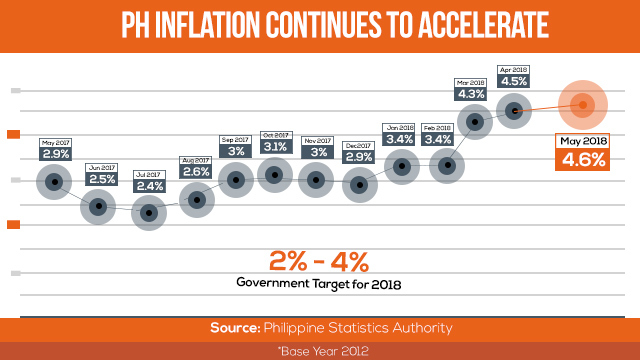
Inflation, or the movement of prices of basic goods and services, is now at a 5 year high, and shows no signs of stopping anytime soon. Every month seems to bring news of a new rise in inflation rates. April registered an increase of 4.5%, May peaked at 4.6%, June rates were at 5.6%. July rated a 5.7% hike.  

These numbers are way higher than the government target of keeping inflation within 2% to 4% from 2018 to 2022.


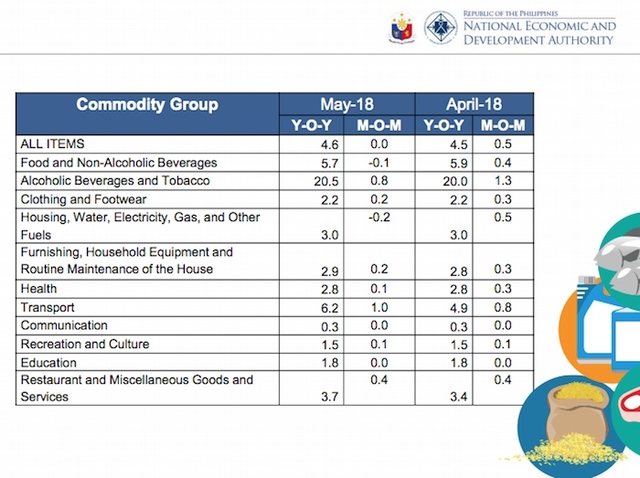
Numbers from NEDA. Pics from Rappler. 


The hardest hit are the poorest Filipinos, who have to pay 6.5% more  for the food, transport and other items they consume. Only education ramped a negative rate. 

Testing the numbers. Calculator by Ace Subido. 


If this continues, it would be handy to know just how much your peso is worth against rising inflation. Ace Subido came up with this inflation calculator that lets you "see how prices in the Philippines has changed over the course of time." The data goes back all the way from 1960, based on numbers provided International Monetary Fund and International Financial Statistics. Recent rates are calculated from the data kept by the Bangko Sentral. 


I plugged in some numbers just to see how it works. This is based on when I joined the work force in 2000. The pay rate at the time was around Php15,000 for relatively fresh grads (although I was still in school when I started working). Over 18 years, and rates have doubled since then. Looking at it this way, it seems like pay has only increased almost at par with inflation. 


If you think about it, that re-dubbed Anak confrontation really doesn't seem so far-fetched. Imagine all those households trying to make ends meet. No matter how hard you work, you will still end up beaten by inflation. It's not like employers are going to adjust work wages to adapt to inflation rates. Although there was a 3% raise on wages this year, that's not even enough to cope with inflation. Super talo pa. Now, who still says that TRAIN was a good idea? 


Saturday, July 21, 2018

5 Ways People are Dumb with Money


Found this interesting digital series from PBS called Two Cents, a series devoted to money matters for millennials and Gen Z. (I'm technically a Xennial or a Gen1 millennial, but who cares?) Anyway, Two Cents has this episode about how there’s this expectation that people would be rational about spending hard earned money. But the thing is, humans can’t quite remove their emotions in the decision making process of spending money. Economist Richard Thaler received the Nobel Prize for Economics for looking at all these totally fallible ways humans are about what should be a totally rational thing. In short, economics is not only about numbers, but about the very human ways decisions are made and how being a mistake prone human needs "nudges" in the right direction in order to modify behavior as well. In short, it's where Psychology and Economics meet. 

The good thing is that these money mistakes are predictable so we could actually avoid them. Here’s some of them: 


Endowment Effect 
The endowment effect is our tendency to assign bigger values to things we already own. Like if we dug up rare single edition Pokemon cards, and discovered that they go for $3k on E-bay, the rational thing to do would be to sell it. Until we decide to hold onto it. Then we see it being sold elsewhere for that amount and decide, eh, that’s just too expensive for a toy. 

There’s a Facebook page online for the place I work for. You could sell your stuff on it. For the longest time, a kid has posted the complete series of a certain manga. Most people would sell their stuff less than the original cover price, but this poster insists on maintaining the pristine, brand new price for a set of books that’s already several years old. It’s not that even rare. But one has to admit that the item is quite niche and only a few people would be interested in it. 

Sunk cost fallacy 
Like if you went to a movie that’s really bad and feel like walking out, but you stay so you can get your money’s worth. The episode also talks about membership clubs (think S&R or Landers) that charge an annual fee and you get perks in exchange. People will buy stuff they don’t need because they want to get their money’s worth. 

Sometimes I’m like this with lunch. My break is still within reasonable lunch hours, but usually all the good food would be gone, and only slim pickings remain. One time, all that was left was some stir fried okra (I don’t know what it’s called really) and then egg and cheese omelet. I felt so sad but also hungry, and only have a short break in between so I gotta eat. I ate the omelet, and I feel bad for wasting food (and money), but I just could’t bring myself to eat that okra and dumped it in the trash. Wala na, ayaw na, couldn’t finish na. Sunk cost na. 

Transaction Utility 
This amount of pleasure or pain that we get from feeling we paid less or more. In short: are we getting a bargain or a rip-off? It’s often totally disconnected from the happiness that you get from the thing itself. 

This is how malls sucker us with their never ending sales. You see that big red banner announcing “Sale! 70% off!” We buy it because it seems like there’s a markdown from the original sticker price. So we buy things, and more things that we don’t even need and all because we think we’re getting a discount. Instead, it might be more useful to see it as spending 70% more than 0 if you don’t buy that stuff unless you really need it. 

I like shopping End of Season sales. You do get a lot of bargains, lalo na for work clothes. But I make it a point to scout the things I want before the sales so that I know what the “regular” prices are. Then when the sales start and I still need it, or want something, I can check if it’s really going for a lower price. 

It’s also useful when you know the cycle of when these sales happen. Last year, my laptop broke down after 7 years. Sulit na. But I still waited for a sale and used my tablet in the meantime. When school was about to start, there’s an Education related sale. But the store was only giving out a 5% discount for the cash amount + freebies. The store has changed their cash sale policy na raw. The last time I bought a computer it was 10% for buying in cash.* I really needed the computer by then, and I still got a discount of 5%. Then two months later, my friend buys a computer. I’ve told her about the cash discount. Lo and behold the cash discount was back to 10%, and there was some freebies, too. You gotta believe I felt real bad because she paid much lower than I did. Oh well. Basta I hope the computer lasts just as long para sulit ang money. 

Mental Accounting
There’s also mental accounting, or separating money into imaginary categories in your mind. It’s useful when we think of it in terms of setting a budget. We invent categories like fun, free, expected or serious money. It violates the rule that money is “fungible,” i.e., totally interchangeable. A hundred pesos is still one hundred pesos however way you got it. Lets say you got Php1k on a raffle, should you use it to buy Php1k of shoes, eat out at a fancy place, go travel? But we shouldn’t think of it as free money. How would you spend the 1k if you worked for it? But most of us will just spend it, since we didn’t work for it anyway—it’s free! 

I know the episode listed 5 things, but for the life of me, I could only count 4. Or maybe I didn’t watch properly. But really, it was informational for me to see how mostly, it’s a battle between being rational about things or being emotional. Sometimes we know the right thing to do, but the heart still wins. Mahirap mag-abdicate ng emotion—specially if it has something to do with family. 

*When work mates noted my new laptop and asked how much it was, I didn’t say that I bought it in cash. Since I have always heard people (even our boss then) used credit cards and paid for the purchase in installments. Everyone was like, nobody has money for that. So I felt a bit ashamed and just said that the overtime check we recently got plus savings were what I used to buy the computer. But now I know better.