Showing posts with label retirement. Show all posts

Thursday, December 15, 2022

Do we really need the Maharlika Wealth Fund? (Or thinking about pensions and retirement in 2022)

"What has life to offer me, when I grow old?" 
 
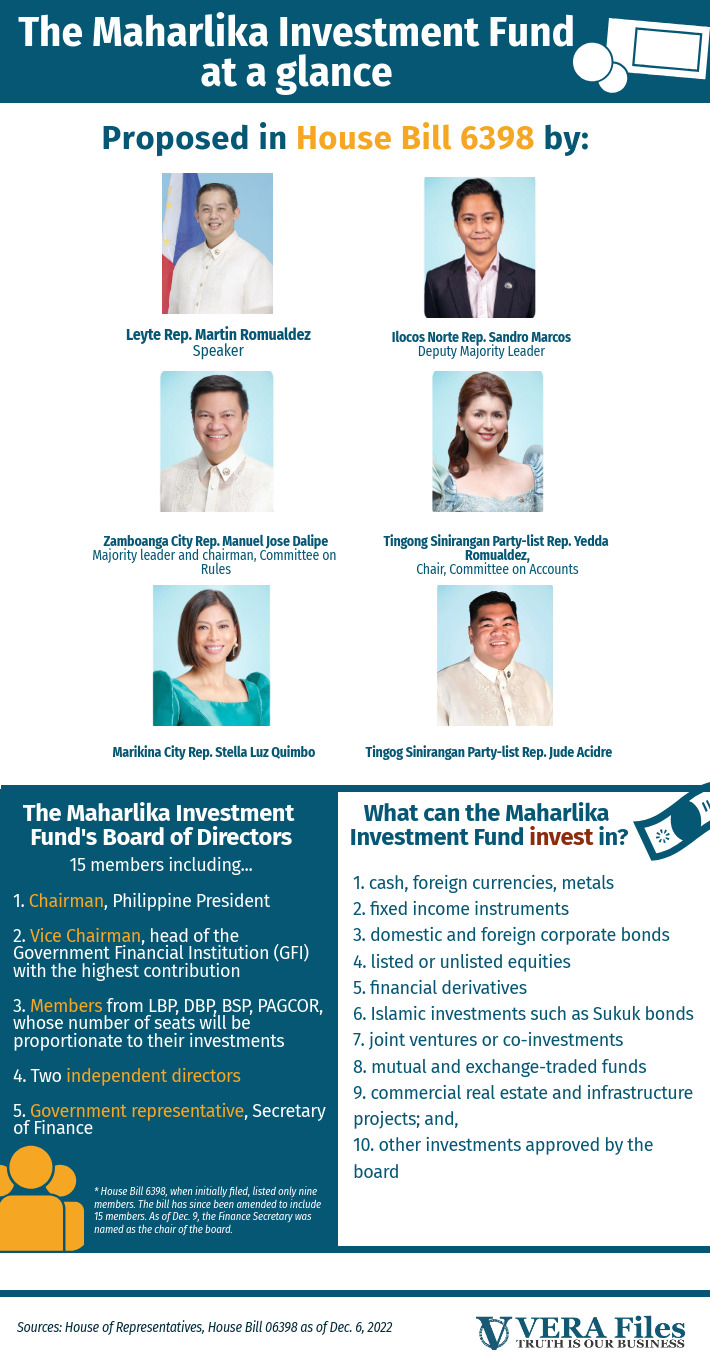
Lead vocalist Wency Cornejo asked this question around thirty years ago when the song "Next in Line" ruled the local radio airwaves. And now this question is top of mind because for the past month, the source of public uproar is the Maharlika Wealth Fund, which this Department of Budget and Management PR describes as "a sovereign wealth fund which will be used by the government to invest" in, among other things, "foreign currencies, fixed-income instruments, domestic and foreign corporate bonds, commercial real estate, and infrastructure projects."

 
First off, the name itself is sus (as young folks say). "Maharlika" is technically the feudal warrior class, but the ordinary Pinoy understands it as the nobility class -- or the alta and elite in our society. What's more shady though is its association with the elder Marcos: it's the title of the 1970 film which stars his mistress Dovie Beams and detailed the supposed (and fictional) exploits of Soldier Marcos' bravery during World War II -- a sham that's been proven several times over, but has been dusted and peddled anew to rebrand the Marcos years as the country's "Golden Age." (Interestingly, "Maharlika" has apparently been re-released in 1987, after the dictator has been ousted. The poster above is from the Video48 blog.) Who's behind this scheme?
Now we get the younger Marcos' cousin Ferdinand Romualdez, his wife Yedda and another same party list cohort, Bongbong's son Sandro, a representative from Zamboanga who is probably is also a close "family" associate, and a surprise stooge in "Teacher" Stella Quimbo of Marikina---sooooo disappointing, btw--pushing the HB6398 proposal in Congress and that they want to certify as "urgent." 

Then there are the government shills. In the DBM's PR piece, current Secretary Mangandaman, shares her "optimism" on "behalf of the Economic Team." Joey Salceda and Finance Secretary (and former BSP Governor) Benjamin Diokno want us to believe that this fund that wants to "invest" the GSIS and SSS pension funds of our citizens in a scheme that doesn't have enough checks and balances that could leave destitute our future senior citizens, hardworking ordinary folks who are counting on these pensions in their old age. 

How the fund proposes to earn is by putting our hard earned money in derivatives (a complicated financial instrument that played a role in the 2008 financial crisis), "alternative investments" like unlisted equities, which are "shares from a company that are not registered in the stock market." Later on, the proponents even said that they would use MWF to "take back control" of our National Grid because it was being run or controlled by the Chinese -- which are actually the Sy (of SM) and Coyiuto families. 

There are already many articles online that explain in more detail why the Maharlika Wealth Fund is dangerous. Vera Files has an amazing fact sheet. Ricardo Saludo of the Manila Times asks, "What's in it for the poor?" Something that was "hardly asked in the debates," he noted, as it mostly focused on investment risks and transparency issues. Saludo asserts that the MWF is not a "strategic" thing to do for a "less endowed country" such as ours. Sovereign wealth funds are usually "what prosperous, progressive nations do." Is the MWF the right thing to do when your country is battling inflation, doesn't have sustainable pensions for its senior citizens, and insists that P488 is enough for a bare minimum nochebuena of 5 people? There are many things the Philippines should be considering before establishing a sovereign wealth fund.

Heck, even the immortal Enrile remarked that we should "carefully review" the MWF. 
 

One of the more shocking (or maybe shouldn't be shocking) pieces of information I found out in the course of following the Maharlika debacle is that only 20% of senior citizens (defined as age 60 and over) in the Philippines benefit from a retirement fund system. This presentation by Christian Mina and Faith Cacnio, which I found through the PSA website, asks if Filipino senior citizens are financially protected, and they presented evidence based on a consumer finance survey. Their survey and data set is from 2014, but I think it's still relevant for the purposes of this post. 

Mina and Cacnio found out that social security in the Philippines was linked with the "formal employment," so basically people with regular jobs. Mina and Cacnio's main takeaway from this survey is that the vast majority senior Filipino citizens (or around 75%) who were their family's breadwinners (or "economically dominant persons" according to the document's preferred jargon) were not covered by retirement plans. 

Of the 20% who receive pensions, the split was 15-16% from SSS (or the private sector) and 4% from GSIS, or those with government jobs. But they also characterize SSS pensioners as belonging to the "poorest 40%" and were likely to be receiving monthly payouts of P4,000 or below. Meanwhile, only 4% (we're assuming these are the GSIS pensioners) are getting Php 30,000 or more, an amount that's more likely to cover their consumer expenses. 

There's a real divide between the economic situations of SSS and GSIS members in retirement, with those who worked in government jobs more likely to own a house with 3-4 bedrooms and built with sturdy materials, own a business, smaller number of dependents -- most of whom are old. The SSS pensioners are more urban, poorer, have smaller houses built with less durable materials, and are likely to be supporting younger dependents. 

It's also worth noting that those 60 years old and older in 2014 were born 1954 and earlier -- so definitely Boomers. They worked hard and are getting something but still not enough. 

And we're not even considering those who are NOT covered by either the SSS or GSIS. Mina and Cacnio characterized them as having had little education ("some elementary"), no real properties, and their homes have "0-1 bedrooms" made of light materials, have no deposit accounts, no emergency money at home, supporting more dependents, and most likely male. These are the manongs who worked "casual" or contractual jobs, but most likely they belonged to the "gray" or informal economy, who made the most diskarte. The DSWD does support indigent senior citizens, but that's a measly Php 500 a month. But guess what, even that is not enough when you go down the line. 

And what about us who are currently part of the labor or workforce? Can we still depend on the GSIS or the SSS in, say, 2040? Boo Chanco's Philstar column from December 12 ("Pension funds") stated that last October, the Philippines was declared to be the "second worst among 44 economies in Mercer-CFA Institute’s Global Pension Index." The main reason: retirees not getting sufficient pensions. Mercer's Global Pension Index evaluates funds according to three criteria: adequacy, sustainability, and integrity. The Philippines ranked last of 44 countries in the integrity criteria, which looks at how a retirement system is regulated, how members are protected, and how much it costs to operate the fund. In terms of sustainability, remember when the late PNoy vetoed adding Php1,000 to pensions, citing the danger that it would cut the fund's life shorter by 7-12 years? Then Duterte shrugged and said, "Give it." That meant the fund can only last until 2047. 

If life permits, I would be among those retiring (or retired earlier, yeah?) in 2048. But by then, THERE. WOULD. BE. NO. MORE. FUNDS. 

So paano tayong mga nagbabayad ngayon? Nganga na lang? Will you still want to contribute to your SSS (and even Philhealth!) if you know you will most likely end up broke even if nag-ipon ka naman? Yes, I understand that the point of these funds is that the current working population is supporting those who worked before and are retired now, and the future generation will support us. Pero paano nga kung di na sapat ang funds? Or if the House of Representatives, the Senate and the current admin's stooges all have their way and use the Maharlika money (our money!) to somehow fund their misguided vendetta against "the Chinese" running our National Grid? Or if they invest in the companies of cronies? Do we get a say then? 

What's remarkable is that the millions of SSS and GSIS current and future pensioners voiced out their anger and that allowed for a few backtracking bits. But if the Speaker of the House wants this bill certified as "urgent" so his cousin can sign it, what now? What then? 

It's no wonder that retirement and familial support is froth with tender wounds and difficult decisions. In online discussion boards and even social media, the current generation of workers and breadwinners is starting to push back against the widespread belief and practice that the "anak as retirement fund." It's so bad that there are "Panganay Support Groups," with a very specific "eldest daughter in an Asian household" slant. The ongoing narrative is that of greedy and abusive parents basically gaslighting their children into "giving back" more and more support, of asking the elder child to finance the education of younger siblings, of funding the family expenses, that it is the child's responsibility to lift the family out of poverty ("iahon sa kahirapan"). (If you want tea of this kind, just search for online gamer H2WO's problem with his mom. It's a long read, but typical of the parent asking excessive financial support from their kid narrative.) 

But really, when you really look at it, it's not entirely the fault of the previous generation. Filipinos are "indisposed" to saving -- maybe because we don't even have enough for the day to day to begin with. How can you think of the future if today's hunger has to be fed? This is where the government steps in. The State should take care of its people. Not just its own. But everyone. But if certain people get their way, all that is ours is theirs.


Saturday, August 25, 2018

The Philippines: Best Place in the World to Retire

Got this from an online forum. Credits to the owner.


It's been a few months since Infinity War was shown, and yet memes about Thanos landing in the Philippines keep on coming. This one is extra funny because it's financial life related. Sure, the Philippines is the best place in the world to retire---if you're coming from the third first world and actually have the benefit of a 401k, a retirement package or a pension coming from your employer. 

Tropical third world countries in general come up top as the best places for (usually) white people to retire in because for one, winter is tough for old people. Got to keep them bones and achy joints warm. Two, their euro/dollar/etc go very far in our shores. Like what my aunt used to tell her foreigner husband: lets go back to the Philippines and you'll live like a king. True enough. They get to live in a condo with the supermarket and all the possible amenities nearby. They get vacation time for weeks and months on end. They get relatives who live nearby to run some of their errands. What's not to like? 

But if you're Filipino, retirement in your own country sounds like a scary idea. You can't even run off to other third world countries unless you have saved up and really prepared for your retirement. One option though is to move to the provinces where the quality of life is better compared to Metro Manila. In the city, traffic and air pollution will probably be bad for aging lungs---or just plain bad for everyone, period. If you own land in the provinces, you can probably garden and grow some of your own food. Bonus points if you have relatives in the area to keep you company and to help out, just in case. The one drawback is probably that healthcare is concentrated to capital city hospitals. Can't say much about the state of healthcare in the provinces, but the sheer distance from barrio to the city is going to be worth an hour's travel at least? A compromise could be worked out though: live in the provinces, but choose places where a good hospital is within a reasonable travel frame. If an emergency comes up, god forbid you don't want to be trapped in an island with no ferry to the mainland. 

Prospects about my own future retirement are scary. For one, you really can't depend on the government pensions to fund your old age. My mother's pension from the SSS is a measly Php1,200 per month--granted that she stopped working after my siblings were born. She gets this Senior Citizen Fund of Php5k per year. So that's not really much and us siblings have to pick up the slack for whatever's left. This is how most Filipino families take care of their older members. 

I really hope this changes and there's more awareness about preparing for retirement with people my age and younger. Because we can't keep on going on like this. Just the news of the SSS hiking pensions again will mean that the fund life will be cut to 2026---there really won't be anything left decades before I (and my cohort) will be ready to retire. 

The message really seems to be: don't depend on anyone for your retirement. Not the government, not your children (if you have any). Because unlike Thanos, we don't have Infinity Stones and the Banaue Rice Terraces to fall back on. You're the only one responsible for your own future self. So do yourself a favor and prepare for your old age now. Don't buy unnecessary stuff to show off. Stash part of your income in a fund--mutual, stocks, VUL, PERA, pension funds---do it now. Your future self will thank you. 

Wednesday, January 3, 2018

Preparing for retirement with PERA


In a previous post, I looked at how the TRAIN would affect my take home pay. 

TRAIN promises to cut the withholding tax. From my previous effective rate of 32%, it will go down to ~9.2%. That savings will go a long way to fund my retirement. So while it might be tempting to use that "free" money to live the best life now, I'm opting to invest it for my best life in the future. 

Although I contribute to the SSS--it is mandatory, after all--I'm giving it the side eye. For one, there's the talk that the SSS assets would be depleted in 28 years if crucial reforms are not implemented. Which means the SSS is possibly not  around by the time I'm retiring. So I thought I should prepare for that bleak future scenario. At any rate, no one should be counting on just the government pension. I mean, the minimum pension right now is pegged at Php1,200. Who could live with just that money? 

Anyway, I was still working in government when the PERA law was approved in 2008, but implementation is another matter. There was buzz in 2016 that it would go live, and it did in December 2016. But the only two approved entities--BDO and BPI--only had mentions of it but no actual product yet. 

Even before the approval of the TRAIN, I was already thinking of seriously saving for retirement. In the international (mostly American) finance blog circles, it's all about ETFs or index funds. So I was looking at index funds. And then I thought of PERA to at least get a 5% tax credit for saving.  

I made inquiries with BPI already. I knew from other posts that one has to go to the head office to open a PERA account. However, when I checked with the BPI website, this FAQ states that starting January 2017, there should be several branches aside the main office that could facilitate opening a PERA account. I went to my local branch to ask if that policy had changed. The girl at the accounts desk called the head office to confirm and to ask for the requirements as well. 

This is how you open a PERA account with BPI: 
  1. Yes, you need to go to BPI's main office in Makati. Go to the 17th floor, Assets Management. 
  2. You need to bring your TIN ID. In the event that you don't have an ID, bring your ITR as it would have details they need to open a PERA account. 
  3. You must have a BPI savings or checking account. 
  4. a valid government ID. 
  5. Fill up their form, which gauges your investment risk profile 
BPI offers 4 kinds of PERA accounts, which are very similar to mutual fund or UITF offerings. They have a money market, government bonds, corporate bonds and an equity fund. 

Of course, there are fees: BPI asks for a 1% administrator fee based on the amount contributed. There are also "transactional and annual fees from the Cash Custodian as well as trust fees from the respective PERA UITFs." The Equity Fund lists a 1.5% per annum trust fee. I wonder if this is the same as or probably on top of the 1% admin fee. 

Meanwhile, BDO's PERA Equity Index Fund lists a 1% p.a. "management fee." Again, will need to clarify if this is on top of or the same as the admin fee. But I still need to inquire with BDO.  

If we go by fees alone, I'm partial to whoever is offering a lower fee. Then there's the matter of who offers an index fund. There's also the ease of transacting. BDO is attached to my payroll account, that would make it easier for me to transact. That matter of only having one administrator for your PERA accounts certainly has to be considered. 

All in all, I still need to check with BDO and then weigh which one between the two banks will get my retirement money. But even then, BSP Deputy Governor Espenilla acknowledges that the slow rollout is because there are only ~100 professionals dealing with PERA.  It would certainly give the investing public more breadth of choices if other entities would come in and offer their own PERA funds. Until that day comes, it's a coin toss between these two candidates. 

Tuesday, January 2, 2018

How to Ride the TRAIN with reservations

The gift that keeps on giving. You do you, Alma. 


The first part of the Tax Reform for Acceleration and Inclusion (TRAIN) was signed into law in December of last year. Its main selling point was that those earning Php250k annually will no longer have to pay the income tax. While a lot of people find this a cause for celebration. 

Like Alma Moreno, I still have my own reservations about this whole exercise. I do recognize that we will have a bigger take home pay, but I also know that we will be taxed in other ways. Like the price of anything that uses oil or sugar will surely go up. Hello, fare hikes and no more unli-softdrinks. (Not that I'm a big fan of soda, anyway.) 

But I want to look at this positively, so I want to focus on how the TRAIN will make our take home pay bigger. Every year around tax time, I just grind my teeth at how much tax the government takes away. I mean, it's fine if you see that social services are efficient or that government officials are competent. Just knowing that your tax money goes to someone else's already deep pockets and yours are butas, that's just a major bummer. 

In the pre-TRAIN tax regime, I get taxed ~25-32% because I am single, have no dependents, and earn from multiple compensation. A part timer is only allowed a maximum of 12 hours a week. So if I work for 4.5 hours a day, I only get 3 hours because the 1.5 is already eaten up by taxes. Your payslip may show that you get a sizeable amount, but the reality of what shows up in your ATM is another matter. A third of your salary is no laughing matter. Because in a year, that amount balloons to more than 6 digits. Monthly, it's enough to pay an amortization for a condo or a house. But in reality, I can't even qualify yet for a housing loan--I'm a part timer, and my salary is under 50k. So yes, a bummer. 

Photo courtesy of ABS-CBN reporter Alvin Elchico. 


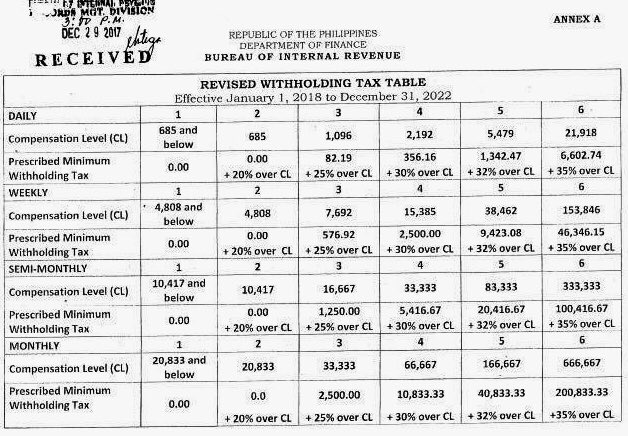
In the new TRAIN Revised Withholding Tax Table, my income category falls under the 30k + 25% of the excess over 400k. Which means roughly my annual income tax will now fall under 50k, which is a whopping reduction coming from around 3x that amount. From a condo amortization, pambayad na lang ng parking---kung may kotse ako. Eh wala so nganga. Hahaha. 

But seriously, if the tax computation table is indeed true, that is an additional 7k or so to the monthly take home pay. 

What to do with this "free" TRAIN money? 

Not going to spend it on #travelgoals, that's for sure. Will most likely funnel it into a retirement account, aka the long delayed PERA. 

As for which entity and fund, that will come in another post.